
 English
 Español
 عربى
عربى русский
Contact Us
Your email address will not be published. Required fields are marked *
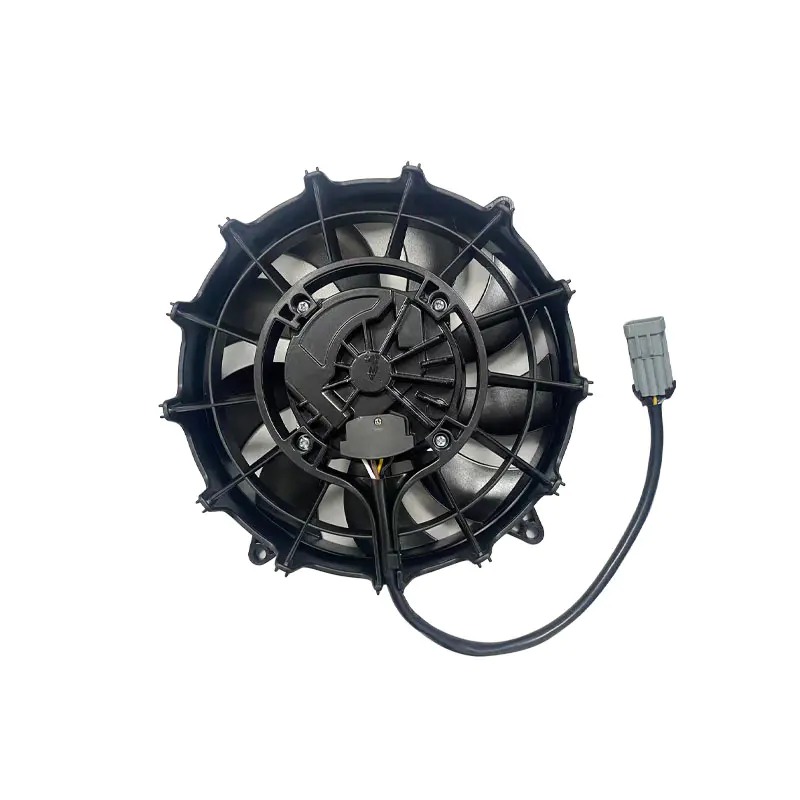
Swap a brushed DC motor for a brushless one in a centrifugal fan and almost every spec that matters improves at once — efficiency goes up, noise goes down, and the maintenance schedule that used to include brush replacement disappears entirely. A brushless centrifugal fan is built around that single change.
Removing carbon brushes does not just extend lifespan — it changes how efficiently electrical energy converts into airflow at every operating speed.
A brushless centrifugal fan draws air into the center of a spinning impeller and throws it outward by centrifugal force, building higher static pressure than an axial fan moving air straight through in one direction.
That pressure advantage is what lets centrifugal fans push air through filters, ducts, and tightly packed electronic enclosures where an axial fan would stall against the resistance.
Voltage and rated current set compatibility with your power system and determine baseline energy draw.
Airflow volume defines how much air moves per minute under free-flow conditions.
Static pressure determines performance against filters, ducts, or restricted enclosures.
Fan speed and noise level trade off against each other, so sensitive environments need a fan sized to run slower.
Impeller diameter influences both airflow capacity and physical footprint.
Operating temperature range confirms the fan can survive its installation environment long-term.
| Feature | Brushless Centrifugal Fan | Brushed Fan |
| Motor type | BLDC motor | Brushed DC motor |
| Maintenance | Low | Brush replacement required |
| Speed control | Advanced, PWM-based | Limited |
Electronic commutation and balanced impeller designs reduce mechanical friction and vibration, both of which are major noise sources in brushed motor fans.
Higher static pressure ratings are needed for filtered or ducted systems, since restricted airflow paths demand more force than open-air cooling applications.
Yes, PWM control lets the fan run at the minimum speed needed for current cooling demand instead of a fixed maximum speed, which lowers average power draw.
Their brushless design and reduced mechanical wear make them well suited to continuous-duty applications like data centers and industrial automation equipment.
Your email address will not be published. Required fields are marked *

Zhejiang Nicety Electric Machinery Co., Ltd. specializes in the production of four series of products: condenser electronic fan, radiator (water tank) fan, blower, and air conditioner assembly. Professional production American, European, Japanese, Korean And Domestic brand DC automotive axial fans.
Email: [email protected] / [email protected]
Tel: +86-0578-7125439 / +86 181 0658 9231
Address:No. 98, Guangda Street, Jinsha Industrial Zone, Longquan City, Zhejiang Province, China