
 English
 Español
 عربى
عربى русский
Contact Us
Your email address will not be published. Required fields are marked *
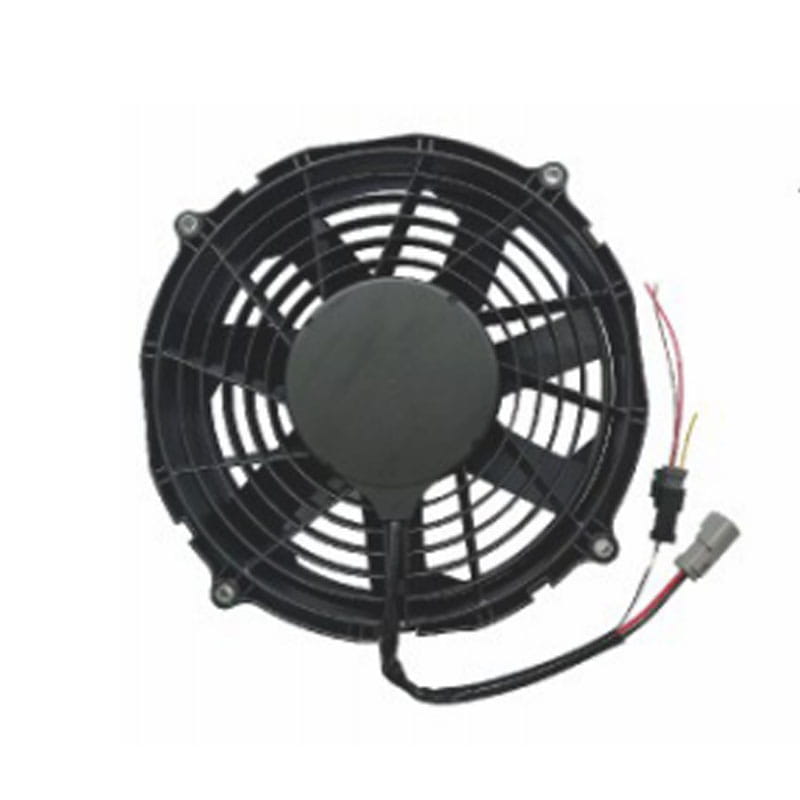
Automotive DC centrifugal fans are indispensable for EV thermal management, directly ensuring battery safety, power electronics reliability, and overall vehicle efficiency. Unlike axial fans, their design generates higher static pressure, making them uniquely suited to overcome the resistance of dense battery packs and intricate cooling ducts. This capability enables them to enhance heat dissipation efficiency by up to 30% compared to traditional cooling solutions in constrained engine bay environments.
In practice, these fans actively pull air through the battery pack’s finned heat exchangers and push it across high-power IGBT modules. By maintaining a consistent thermal gradient, they prevent hotspots that can degrade cell chemistry and reduce the risk of thermal runaway.
DC centrifugal fans offer distinct benefits that align with the specific demands of electric vehicle platforms. Their operational characteristics translate directly into measurable performance and durability gains for OEMs and Tier 1 suppliers.
Centrifugal fans excel in generating substantial static pressure, a critical factor for forcing air through densely packed battery modules and heat exchangers. This is essential for battery thermal management systems (BTMS) that require consistent airflow against significant resistance. Typical static pressure values range from 800 Pa to over 1500 Pa in high-performance variants.
The compact design of DC centrifugal fans facilitates seamless integration into the limited under-hood and under-floor space of modern EVs. Their low voltage (12V or 24V) and 48V variants support precise thermal control, making them ideal for high-density power electronics cooling. The radial airflow path also allows flexible ducting layouts.
Advanced models feature integrated smart controls with CAN, LIN, and PWM interfaces, allowing for demand-based operation and real-time diagnostics. This capability is pivotal for intelligent thermal management, enabling fans to adjust speed based on thermal load and communicate performance data to the vehicle's central ECU. Fault detection and predictive maintenance alerts are also embedded.
The following comparison highlights the key differentiators between centrifugal and axial fan technologies when applied to EV cooling systems.
| Feature | DC Centrifugal Fan | DC Axial Fan |
|---|---|---|
| Static Pressure | High (up to 1500 Pa) | Low to Medium (≤ 400 Pa) |
| Airflow Direction | Radial (90° turn) | Axial (straight through) |
| Best Application | Battery packs, BTMS, power electronics | Condenser cooling, cabin ventilation |
| Noise Profile | Broad-spectrum, lower tonal peaks | Higher tonal noise at blade-pass frequency |
| System Resistance Tolerance | Excellent — maintains airflow under high backpressure | Moderate — flow drops sharply with restriction |
This data confirms that centrifugal fans are the preferred choice for high-resistance thermal loops in battery electric vehicles.
A typical closed-loop cooling strategy employs DC centrifugal fans in a cascaded control architecture. The diagram below illustrates the signal and airflow path in a modern EV battery cooling loop.
This closed-loop response ensures that fan speed is precisely modulated, reducing energy consumption while maintaining optimal cell temperature windows (typically 20–40 °C).
When selecting or specifying DC centrifugal fans for EV programs, engineering teams should evaluate the following critical parameters:
Adhering to these specifications ensures robust thermal performance and long-term reliability, reducing warranty risks for high-voltage battery systems.
High-quality brushless DC centrifugal fans are rated for > 20,000 hours at 85 °C ambient, with bearing systems (e.g., dual-ball or FDB) designed for automotive vibration profiles. Real-world field data indicate maintenance-free operation over 150,000 km.
Smart PWM control enables ramp-up to full speed in under 1.5 seconds, effectively managing the 2–3× increase in heat generation during 150 kW+ DC fast charging. The high static pressure ensures airflow penetrates the battery core.
Yes — centrifugal fans are often paired with liquid-cooled cold plates in hybrid thermal architectures. They provide air-side cooling for radiators and condensers, while liquid loops handle direct cell cooling. This dual approach improves overall system efficiency by 12–18%.
Modern fans output speed feedback, current draw, and fault flags via LIN or CAN. Abnormal current patterns or speed deviations can indicate bearing wear or impeller imbalance, enabling early failure prediction and condition-based servicing.
Your email address will not be published. Required fields are marked *

Zhejiang Nicety Electric Machinery Co., Ltd. specializes in the production of four series of products: condenser electronic fan, radiator (water tank) fan, blower, and air conditioner assembly. Professional production American, European, Japanese, Korean And Domestic brand DC automotive axial fans.
Email: [email protected] / [email protected]
Tel: +86-0578-7125439 / +86 181 0658 9231
Address:No. 98, Guangda Street, Jinsha Industrial Zone, Longquan City, Zhejiang Province, China